It’s the last week of October. Half your class is wearing some piece of a costume “just to test it,” someone has already eaten a fun-size candy bar before the morning bell, and you still have a writing block to teach.
Here’s the good news: First graders have a lot to say about costumes, candy, and anything spooky. The trick is giving all that excitement somewhere to go. This post shares six Halloween writing activities for first grade that fit into your lesson plans and don’t require a single minute of your weekend.
1. Build a Halloween Word Wall First
Before students write a single sentence, give them the words. When a first grader wants to write about a skeleton but can’t spell it, you get one of two things: a blank page or a line of kids waiting at your table.
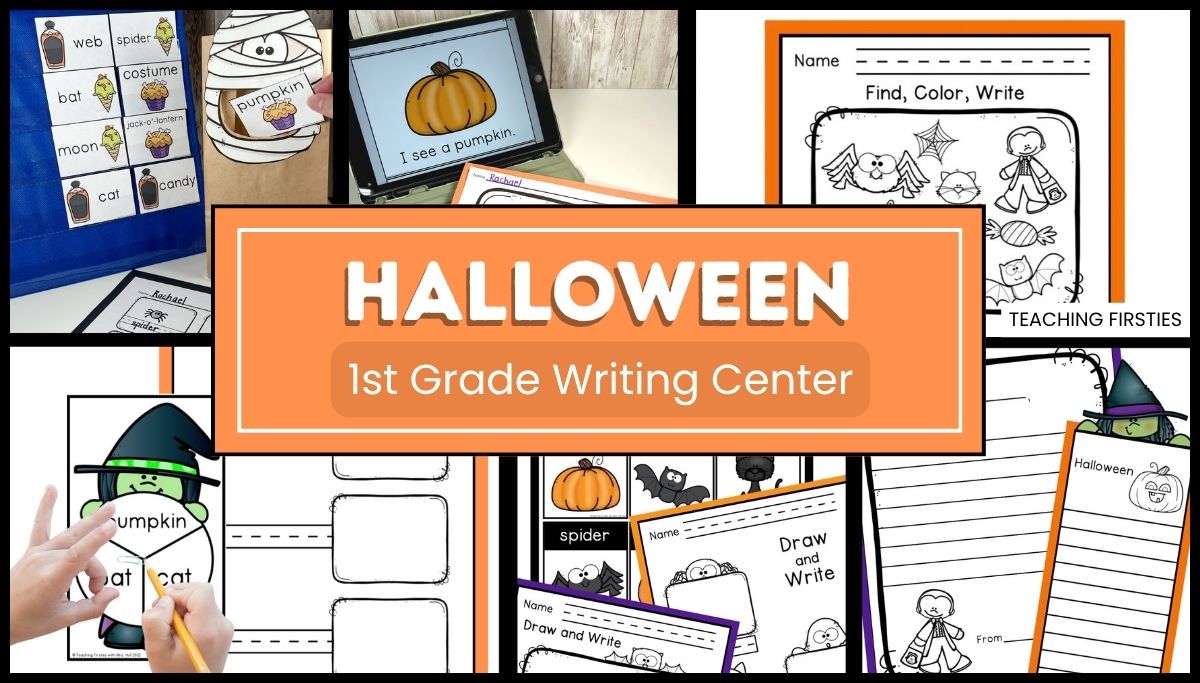
Post 6–10 Halloween vocabulary words with a picture beside each one. Choose from words like pumpkin, costume, bat, witch, ghost, spider, candy, moon, owl, cat, jack-o’-lantern, trick-or-treat. Read them together, clap the syllables, and talk about what each word means.
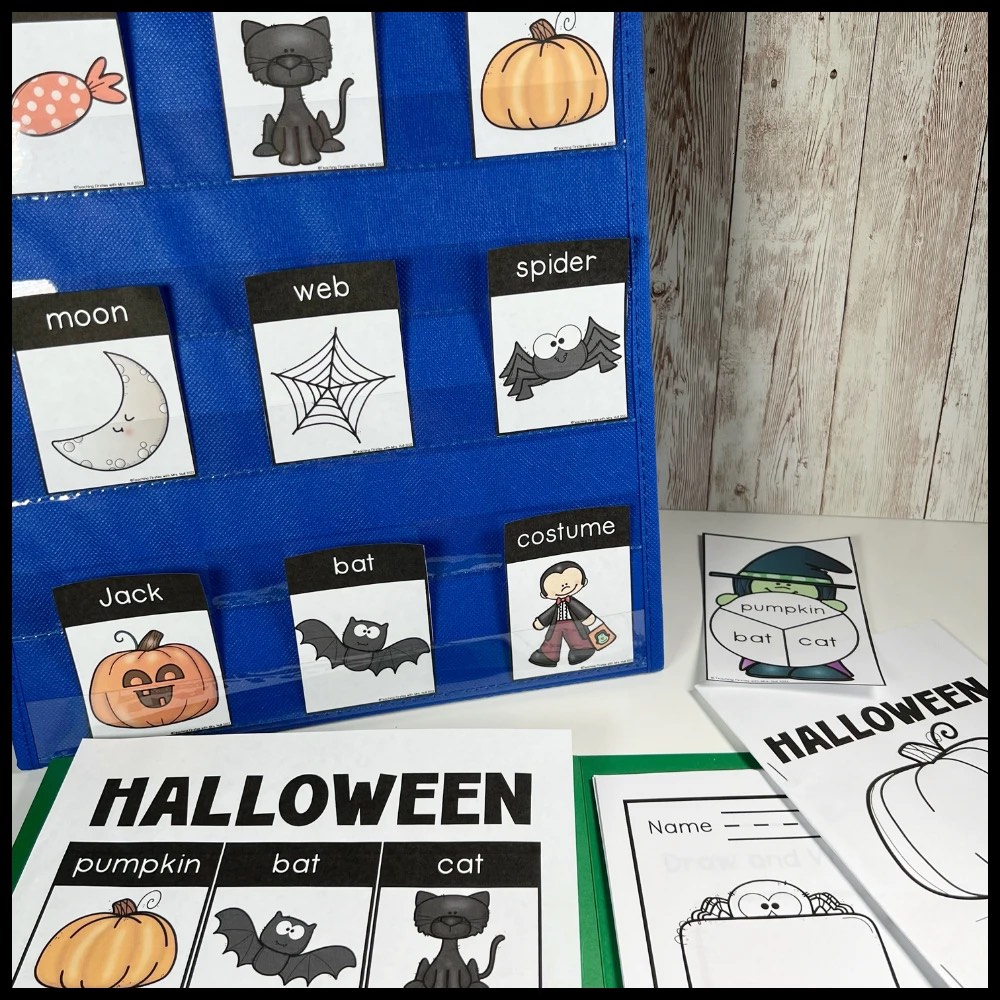
Pro Tip Keep the word cards at eye level in your writing center, not across the room on the wall. If students have to get up and walk to find a word, they’ll stop writing to chat on the way.
2. Spin a Word, Write a Sentence
This is the activity I reach for when a student tells me, “I don’t know what to write.” A topic spinner takes the decision away. Students put a paper clip on the center of the spinner, hold it in place with a pencil, spin, and write about whatever word they land on.
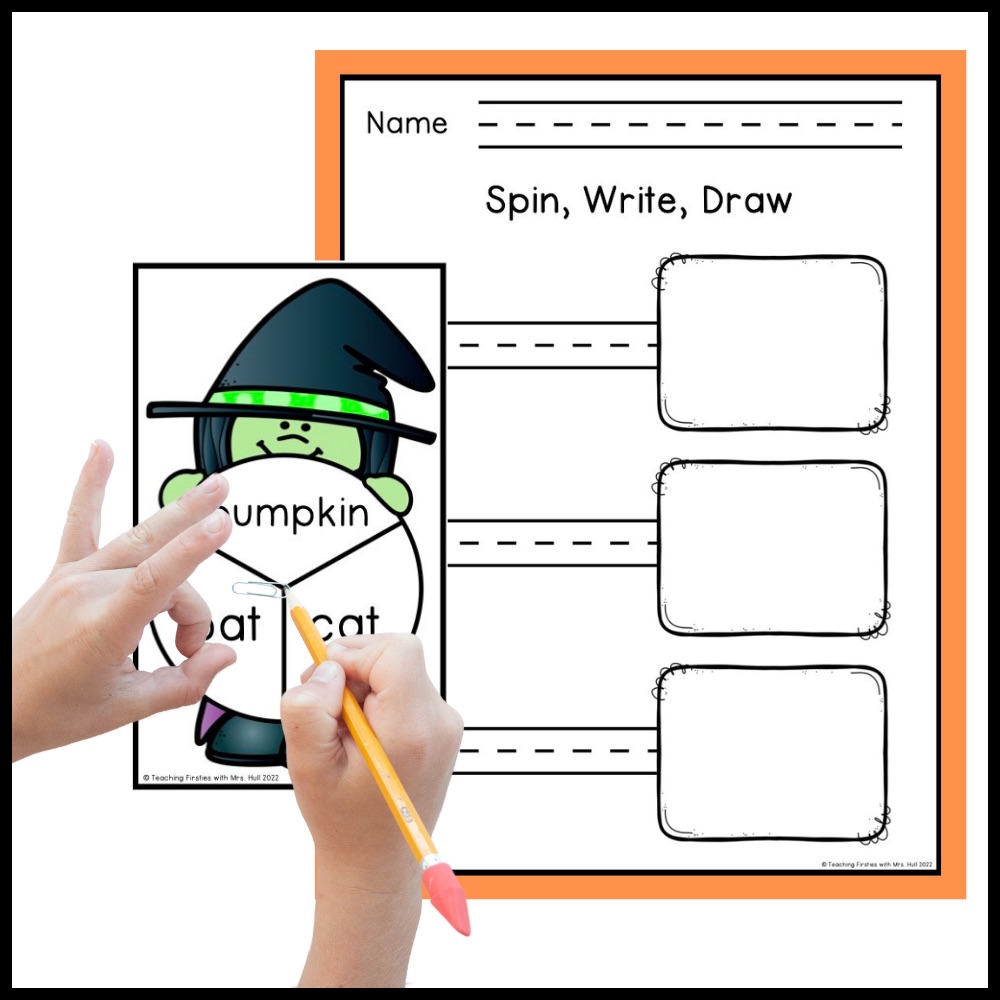
Problem Students stare at the page because an open prompt like “Write about Halloween” is too big.
Solution A spinner with eight pictured words gives students a starting point, and a sentence frame like “I see a ___” or “The ___ is ___” gets them moving.
Early writers can write the word and draw it. Most students write one sentence. Your strongest writers can spin three times and connect all three words in a short paragraph. You have the same activity for three different writing levels.
Free for first grade teachers
Free pumpkin writing paper
Pumpkin-themed writing paper for October writing centers, ready to print today.
3. Draw and Write a Costume Story
Narrative writing is hard for first graders because they have to put events in order. Writing about costumes makes that easier, because every student already has a story about getting dressed up.
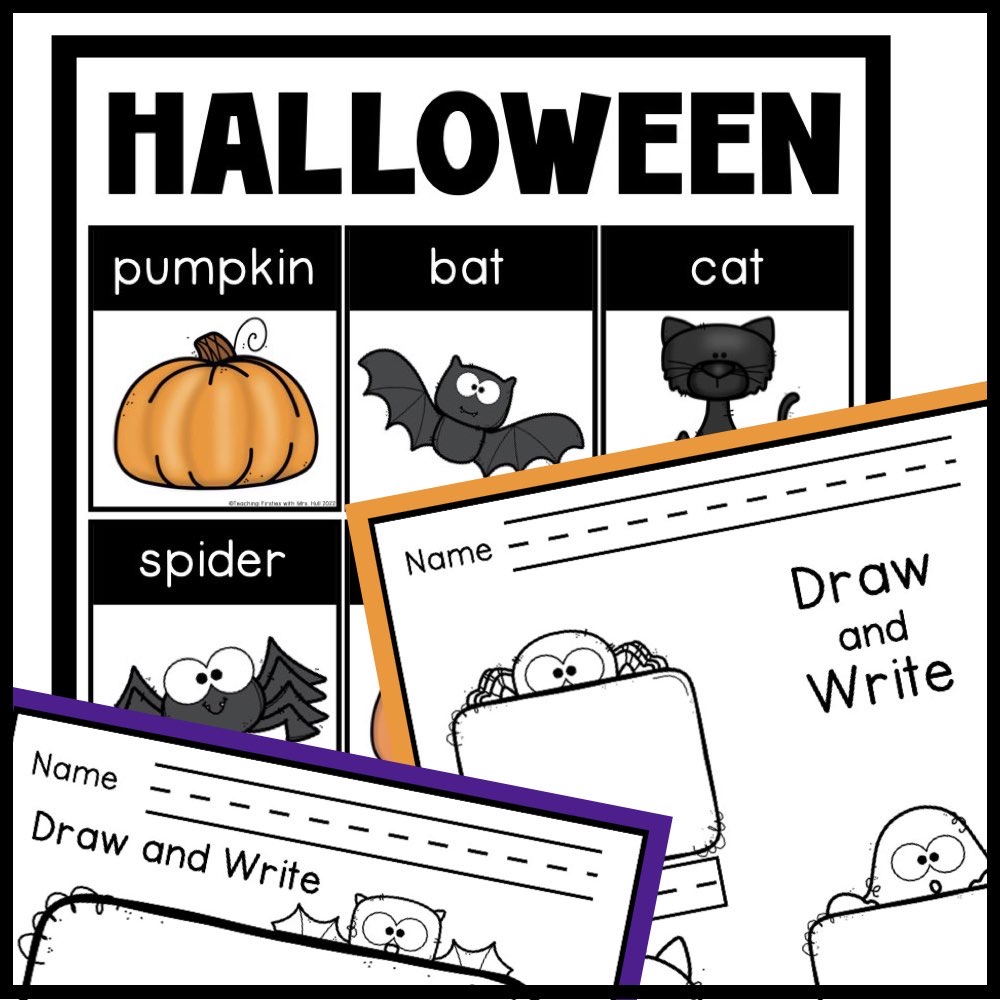
Have students draw three boxes: getting ready, going out, and coming home. Then they write a sentence for each box using sequence words:
- First – “First I put on my dragon costume.”
- Next – “Next I went to my neighbor’s house.”
- Last – “Last I ate one piece of candy. Okay, three.”
This lines up neatly with W.1.3: students recount two or more events, in order, with temporal words. It doesn’t even feel like a standard to them.
4. Write What You See: Describe a Jack-o’-Lantern
Put a real jack-o’-lantern (or a photo of one) in the center and ask students to write what they notice. Descriptive writing gets much stronger when there’s something real in front of them.
Give them a quick checklist of senses: What color is it? What shape are the eyes? How does it feel? What does it smell like? If you ran a pumpkin investigation day, students already have the vocabulary for this.
Pro Tip Push for one “juicy” word per sentence. “The pumpkin is big” becomes “The pumpkin is gigantic.” Keep a short list of juicy words next to the jack-o’-lantern.
5. Teach How-To Writing With Halloween Safety
How-to writing is informative writing (W.1.2) in a kid-friendly format. And Halloween safety is a topic your first graders really do need to think about.
Brainstorm the steps together, then have students write their own “How to Be Safe on Halloween” page:
- Wear a costume you can see out of.
- Hold a grown-up’s hand.
- Carry a flashlight.
- Wait to eat your candy until a grown-up checks it.
Early writers can label pictures of each step. Most can write one sentence per step. If you teach fire safety in October, this is an easy connection, too.
6. Publish a Halloween Mini-Book
End the week by letting students publish. A simple folded mini-book, with a sentence and illustration on each page, gives first graders something they’re proud to read to a buddy, take home, or share at a fall party.
Publishing is what makes writing feel real. Even a two-minute “author’s chair,” where three students read their mini-books aloud, makes the rest of the class want to finish theirs.
Keep Halloween Writing Calm (Yes, It’s Possible)
The secret to a calm Halloween writing block is keeping your routine exactly the same and changing only the theme.
If your students already know how the writing center works in September—where the paper lives, how the spinner works, what to do when they finish—then Halloween week is just new words and new pictures. Nobody needs new directions, and you’re not re-teaching procedures on the most exciting day of the year.
- Same spot, same bins – Put the Halloween materials where the September materials were.
- Same activity order – Word wall, spin and write, draw and write, and publish.
- Same early-finisher plan – A finished page goes in the folder, then students read the room with a pointer.
Differentiating Halloween Writing
Every activity above works at three levels, so you don’t need three different centers:
- Words – Students label pictures, write the spinner word, and use the word wall.
- Sentences – Students write one complete sentence per picture with a sentence frame.
- Short paragraphs – Students write three connected sentences with a beginning, middle, and end.
Let students choose their page when they can, and nudge them up a level when they’re ready. Choice goes a long way on a high-energy day.
A Halloween Writing Center Ready to Print
If you’d rather skip the cutting, laminating, and searching for clip art the night before, we’ve created a Halloween Writing Center with everything in this post: vocabulary cards and posters, topic spinners, Draw and Write pages, Write What You See pages, and a mini-book. It’s differentiated so every student writes words, sentences, or a short paragraph, and it comes in printable and digital formats (Google Slides).
Planning all of October? The October Writing Centers Bundle includes the Halloween center along with pumpkins, bats, spiders, community helpers, and fire safety. That’s one center per week, with the same routine every time.
Final Thoughts
Halloween doesn’t have to be the week writing falls apart. Give students new words, keep your routine the same, and let them write about the things they’re already excited about. You might be surprised how much they write when the topic is candy!